

Best Training Centers for Heavy Machinery in Central Uganda. Central Uganda is the engine room of the country’s economy. Stretching across Kampala, Wakiso, Mukono, Mpigi, Buikwe, and the surrounding districts, this region is home to Uganda’s most active construction corridors, its busiest logistics networks, its largest industrial zones, and its most ambitious infrastructure development programmes. Every road that is being widened, every building that is rising, every bridge that is being reinforced, and every utility project that is being rolled out across Central Uganda requires one thing above all else — skilled, certified heavy machinery operators.
The demand for trained professionals in this field has never been stronger, and the region’s training institutions are the gateway through which the next generation of operators must pass. If you are based in Central Uganda and you are ready to invest in a career that is hands-on, well-paying, and built for the long term, this guide will help you understand what the best training centers offer, what to look for when making your choice, and why one institution stands clearly at the top.
The State of Heavy Machinery Training in Central Uganda
Vocational and technical training has grown significantly across Uganda in recent years, and Central Uganda has benefited more than most regions from this expansion. The concentration of construction activity, combined with proximity to government institutions, international development organisations, and private sector employers, has created a fertile environment for heavy machinery training schools to establish themselves and grow.
However, not all training centers are created equal. Some offer broad programmes with genuine hands-on machine time and experienced instructors. Others offer certificates with little practical value and limited employer recognition. The difference between these two categories is the difference between a qualification that opens doors and one that sits in a drawer. Choosing wisely is therefore one of the most important decisions you will make at the start of your training journey.
The key indicators of a quality training center in Central Uganda include the range of machines available for practical training, the professional background of instructors, the transparency of fees and course durations, and the track record of graduates in securing meaningful employment. Apply these criteria consistently and the best institutions will quickly distinguish themselves from the rest.
Why KCI Institute’s Heavy Trucks Training School Is Central Uganda’s Premier Choice
When measured against every relevant criterion, KCI Institute’s Heavy Trucks Training School emerges as the leading heavy machinery training institution in Central Uganda. Operating as a specialised department within KCI Institute — one of Uganda’s most established vocational learning institutions since 2009 — the Heavy Trucks Training School brings together professional infrastructure, a comprehensive course catalogue, experienced instructors, and a student-focused training philosophy that has produced work-ready graduates year after year.
The school is based in Kampala, placing it at the centre of Central Uganda’s most active employment and construction zone. This location advantage is significant. Students train close to the sites where they will eventually work, build professional relationships with local employers during their training period, and graduate into a job market they are already geographically connected to. To learn more about the institution’s background, values, and the vision that drives it, the About Us page and the About the Founder page together provide a comprehensive picture.
The Full Range of Heavy Machinery Courses Available
One of the most compelling reasons to choose KCI Institute’s Heavy Trucks Training School is the sheer breadth of programmes on offer. The full course listing covers an extensive range of machines and specialisations, making it possible for students to tailor their training to their specific career goals rather than settling for whatever a more limited school happens to teach.
For earth-moving and site preparation work, the school offers the Excavator Operation Training course — a three-week programme that is consistently one of the most popular certifications among students targeting Uganda’s active construction and road-building sectors. The Bulldozer Training course covers land clearing, earthmoving, and slope management over three weeks, while the Grader Operator Training programme delivers four weeks of precision road-building and levelling skills that are in constant demand across Central Uganda’s expanding road network.
For lifting and crane work — among the highest-paying specialisations in the industry — the school offers mobile crane training for both the 5–15 tonne and 25–50 tonne categories, as well as a six-week tower crane programme for those targeting high-rise and large-scale construction projects. These crane certifications are particularly valuable in Kampala’s growing commercial and residential construction scene, where tower cranes have become a permanent fixture on the city’s skyline.
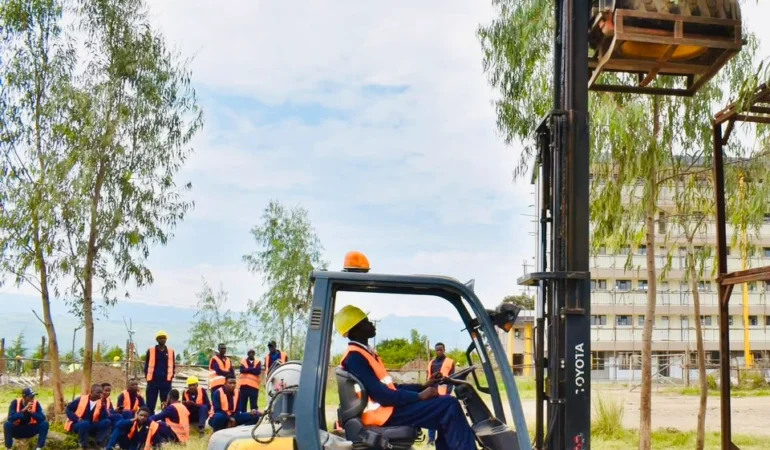
The Wheel Loader Operator Training and Forklift Operator Training courses open doors into quarrying, warehousing, logistics, and industrial environments — sectors that are expanding rapidly across Central Uganda as Kampala’s economic influence spreads into surrounding districts.
Beyond machine operation, the school also trains students in diesel engine mechanics, petrol engine mechanics, hydraulic systems, welding, and boilermaking — giving technically minded students a pathway into machinery maintenance and workshop management roles that complement operational careers perfectly.
Fees and Course Durations Designed for Real People
A recurring complaint about vocational training in Uganda is that the best programmes are either too expensive for ordinary students or so long in duration that they require people to put their lives entirely on hold. KCI Institute’s Heavy Trucks Training School has deliberately structured its programmes to address both of these concerns head-on.
The fee structure page is fully transparent, listing every course with its exact cost for Ugandan nationals and international students alike. There are no hidden enrolment charges, no surprise material fees, and no ambiguity about what you are paying for before you commit. This level of transparency is a hallmark of a professional and trustworthy institution.
On the duration side, courses at the school run between two and eight weeks depending on the machine type and level of complexity involved. Most popular certifications — including excavator, bulldozer, grader, wheel loader, and forklift — are completed within two to four weeks. This means that a student who enrols today could be a certified, job-ready operator within a month, without having to relocate, take on debt, or sacrifice an entire academic year. For a detailed look at how training timelines break down by machine, the how long it takes to learn heavy equipment operation guide is an excellent and honest reference.
Salaries and Career Prospects for Central Uganda Graduates
Earning potential is a legitimate and important consideration when choosing any vocational programme, and heavy machinery operation delivers strong financial returns for certified graduates in Central Uganda. Operators working on major road projects, government infrastructure contracts, mining sites, and international development programmes consistently earn salaries that place them among the better-paid skilled workers in Uganda’s labour market.
The Salary of Heavy Equipment Operators in Uganda resource provides a thorough, up-to-date breakdown of what different categories of operators earn across various sectors and experience levels. Reading this resource before selecting your course is a smart move — it can help you identify which certifications offer the strongest immediate return and which open doors to the highest long-term earning potential.
Graduates from KCI Institute’s Heavy Trucks Training School have gone on to work with major construction companies, road contractors, equipment hire firms, and international project organisations operating across Central Uganda and beyond. The institution’s career opportunities page actively connects trained graduates with relevant employers, providing a valuable professional bridge between the training ground and the job site.
What the Training Experience Actually Looks Like
Understanding what you are signing up for before you enrol is important, and KCI Institute makes this easy. The photo galleries on the Heavy Trucks Training School website offer a genuine, unedited look at what training life looks like — real students on real machines, learning in a professional environment that mirrors actual job site conditions.
The school’s instructors bring authentic field experience into every session. Rather than following a theoretical script, they draw on real-world scenarios, common operational challenges, and practical problem-solving techniques that students can apply immediately on the job. This approach produces graduates who are genuinely confident in their abilities, not just technically certified on paper.
The broader KCI Institute UVTAB courses and admissions information are also worth exploring for students who wish to combine heavy machinery training with other vocational or academic qualifications available at the Kampala campus.
Serving Students from Across Central Uganda
While the school is based in Kampala, it draws students from every district across Central Uganda — from Wakiso and Mukono to Luweero, Mityana, Masaka, and beyond. The short course durations make it entirely practical for students to commute from nearby districts for their training period rather than relocating entirely, keeping personal costs low while still accessing Kampala-quality instruction.
International students from Rwanda, Tanzania, South Sudan, the Democratic Republic of Congo, and other neighbouring countries also regularly enrol at the school, attracted by the combination of affordable fees, comprehensive course offerings, and the credibility of a KCI Institute certification. The Apply Now page on the Heavy Trucks Training School website accommodates both local and regional applicants smoothly.
How to Apply and Begin Your Training
Getting started is straightforward. Visit the Apply Now page on the Heavy Trucks Training School website to select your preferred course and submit your enrolment details. Alternatively, you can apply through the KCI Institute application portal, where both physical campus enrolment and online application options are available to suit your personal circumstances.
Intake is rolling throughout the year, meaning you do not have to wait for a fixed term start date. As soon as your application is processed and confirmed, your training can begin — a huge advantage for motivated students who are ready to move quickly from decision to certification.
Central Uganda’s construction and infrastructure sectors are growing at a pace that the region’s current pool of certified operators simply cannot keep up with. The gap between supply and demand is your opportunity. The best training center in the region is ready to take you from where you are today to where the industry needs you to be — certified, confident, and career-ready.